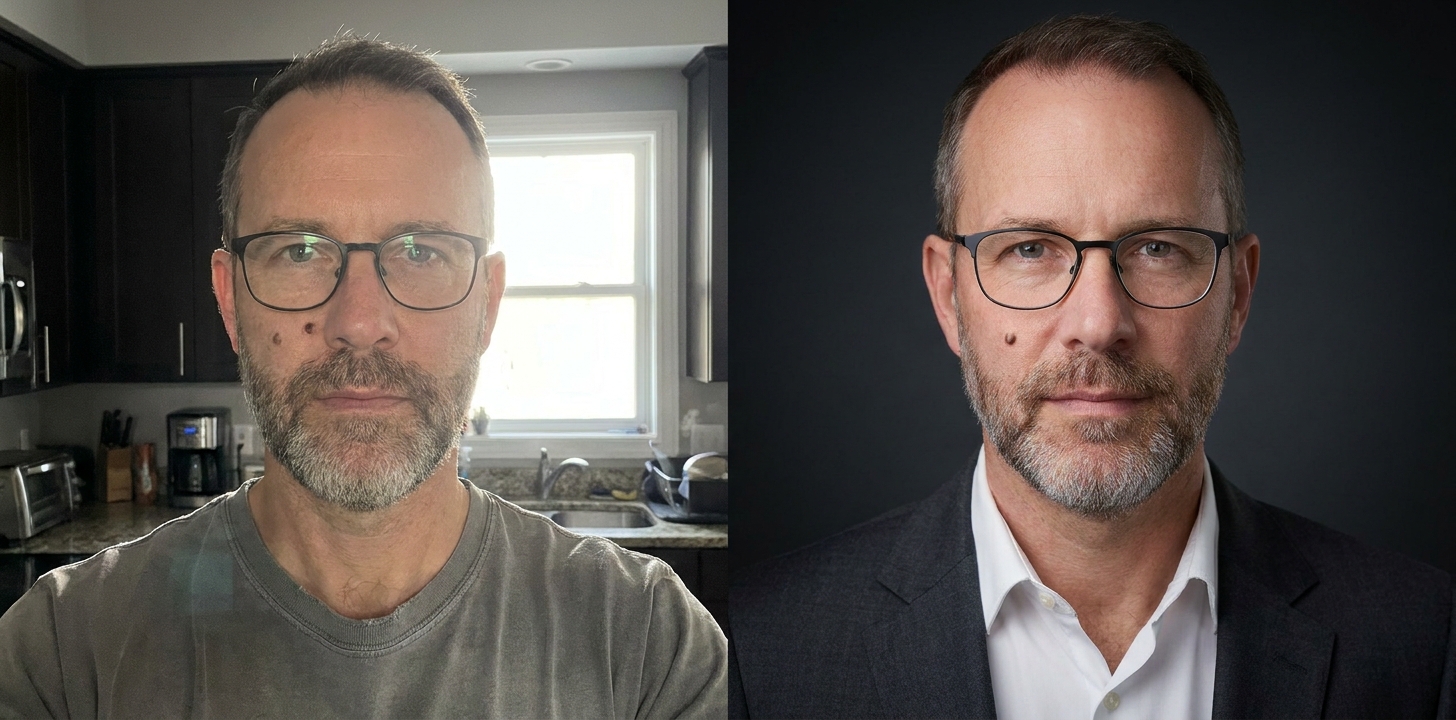
Is an AI-Generated Profile Photo Allowed? (LinkedIn, CV, Work)
8 min read
Équipe TryClothesMagic•Photo professionnelle
photo IALinkedInauthenticitéCVréglementation
The Short Answer
Yes, in nearly every case, on one condition that has nothing to do with technology: the photo has to stay you. A headshot where AI changed the background, the outfit and the lighting, but where your face is your own, breaks no LinkedIn rule, no hiring rule and no law. An image where AI invented a face that does not exist, or took fifteen years off yours, falls into a different category: fake profiles.
The confusion comes from both things being called "an AI photo" while posing entirely different problems. The rest of this article separates them properly.
What LinkedIn Actually Bans
The LinkedIn Professional Community Policies rest on authenticity: your profile must represent a real person, you, and only one. What the text targets is inauthentic profiles: invented identities, photos that do not represent the account holder, automated accounts.
Nowhere does it address how the photo was produced. A studio that lights you, does your makeup, retouches your skin and swaps the backdrop produces an image very far from your morning selfie, and nobody has ever called that a fake profile. The criterion was never the tool. It has always been the likeness.
LinkedIn has also deployed an AI-image detector, with high detection rates reported in the press. Read that for what it is: the tool serves the hunt for fake accounts, not the policing of retouching. What it looks for is fully synthetic faces used at scale to spin up fake profiles, not a sales manager in a borrowed blazer.
The Three-Question Test
Before publishing a generated headshot, ask yourself these three questions. Three yeses and you are on the right side of the line.
Is this my face? Not "a face that looks like me", mine. Features, age, nose shape, scars, moles, asymmetries. If the result erased what makes you recognisable, it no longer represents you.
Would someone meeting me recognise me? This is the most useful test, because reality will run it for you. A recruiter greeting you in reception should see the person from the photo walk in.
Does the photo assert anything false? An office backdrop does not claim you work in that office, any more than a studio backdrop claims you live in a studio. A uniform, a doctor's coat or an operating-theatre backdrop, on the other hand, assert a qualification. That, and only that, is where scenery becomes a lie.
The Three Mistakes That Push a Photo Over the Line
In practice, generated headshots that cause trouble almost always come down to one of these.
De-aging. The most common trap, because it is flattering and easy to let through. A photo that takes ten years off you will be found out on the first video call, and the damage to trust is worse than a bad selfie ever was.
The smoothed face. Some tools erase pores, lines and asymmetries until the texture reads as waxwork. That is not you any more, and it is instantly legible as generated, which costs you the very benefit you were after.
Scenery that asserts a status. A trading floor, a laboratory, an operating theatre or a barrister's chambers tells a professional story. If it is not yours, the problem is not the photo, it is what the photo declares.
On a CV: Nothing Forbids It
In France, and across most of Europe, a CV photo is neither mandatory nor regulated. No text says where it must come from, and no recruiter will ask for the original file. The criterion is exactly the one that applies on LinkedIn: the person who shows up to the interview should be the person in the photo.
The only real risk is credibility, not compliance. An obviously over-retouched headshot on a CV does what a novelty font does: it pulls attention to the packaging at the moment you want it on the contents. A sober, faithful portrait trips none of those alarms.
The One Case Where the Answer Is No: Official ID Photos
There is one case where generating your photo is not just disallowed but pointless: identity documents. For a passport, a national ID card, a driving licence or a residence permit, the French administration requires a photo taken by an approved photographer or in an approved booth, less than six months old, a true likeness, on a plain light background, with a neutral expression. The production chain is part of the standard: an image you made yourself is rejected before anyone looks at its content.
The biometric standard behind these photos aims at a faithful representation of the face, which rules out any treatment that alters its geometry. So: for that kind of document, use the booth. No generator, ours included, belongs in that process, and any tool claiming otherwise will cost you an appointment.
What About the EU AI Act?
The question comes up constantly since the transparency obligations of the European AI regulation came into application. Article 50 requires disclosure of so-called deepfakes: generated or manipulated images that depict existing people and would falsely appear authentic.
How that definition applies to a portrait of you whose backdrop and outfit alone were generated is not settled today, and it is worth resisting the urge to answer in a court's place. What can be said safely: the spirit of the text targets images that mislead about reality, and a photo that faithfully represents you misleads nobody. If your sector is sensitive on this point (institutions, journalism, regulated professions), the sane reflex is to mention that AI was used, which costs nothing and closes the subject.
Staying on the Right Side, in Practice
Start from a recent photo of yourself. A picture of you at thirty used at forty-five poses exactly the same problem as AI de-aging, without the AI.
Check the result at full size, not as a thumbnail. On LinkedIn your photo displays small and anomalies go unnoticed. Open the file large: that is where six-fingered hands, crossed glasses frames and collars melting into necks show up.
Keep a backdrop that asserts nothing. Neutral studio, gradient, blurred office. Scenery that says nothing about your job cannot say anything false about it.
Keep the source photo. If anyone ever asks where the headshot came from, having the original selfie to hand ends the conversation in ten seconds.
Never use a generated portrait for an official document. See the section above.
How We Built the Tool Around That Line
Our generator applies an outfit, a backdrop and lighting to your face without reshaping it. That is a technical choice, and it is also what makes this article's answer possible. We offer no de-aging, no face slimming, and no backdrops that simulate a professional status (no operating theatre, no courtroom). The available backdrops are studios, gradients, a blurred office, a library: scenery that asserts nothing.
The right way to check that promise is not to take our word for it, it is to run it on your own face. You can run a test without creating an account and judge whether the person in the image is you. That is the only verification that counts, and it takes twenty seconds.
In Short
Publish a generated headshot that looks like you, on LinkedIn, a CV, a website or a team page, without worry. Do not publish a face that is not yours, an age that is not yours, or scenery that tells a job that is not yours. And for a passport, use the booth.
If your next question is what all this should reasonably cost, the comparison of real headshot prices answers with observed rates. And if you want to know what makes a good photo in the first place, whatever the tool, start with the LinkedIn profile photo guide.
Try it on your own photo, right now
One photo is all it takes. No account, no card, and your photo is never stored. You see the result on your own face before deciding anything.